Push-around lifts
Moved into position by hand. Elevation may be manual or powered, so “push-around” alone does not tell you whether a machine needs charging.
 Book a demo
HOME / LOW-LEVEL ACCESS GUIDE
A practical guide to compact lifts and working platforms: how they move, how they rise and what to consider before choosing one.
UNDERSTAND THE CATEGORY
Low-level access equipment provides a raised working platform for tasks such as maintenance, installation and facilities work. The category includes compact mast lifts, small scissor lifts and other access platforms. Equipment differs in how it is raised, moved and used.
Often used for indoor work, these platforms give the operator a working area for the task and equipment. Selection still depends on the job and the location; a platform is not automatically the right choice for every task.
“Low-level” is a category description, not a single working-height limit. Compare the actual model specifications and operating instructions with the job you need to carry out.
UNDERSTAND THE DIFFERENCES
These descriptions overlap. Push-around describes travel; manual describes elevation; scissor and mast describe the lifting structure. One machine can belong to several of these groups.
Moved into position by hand. Elevation may be manual or powered, so “push-around” alone does not tell you whether a machine needs charging.
Raised through an operator-driven mechanism, such as a handle. Battery-free elevation removes the charging requirement; the operating method and effort depend on the model.
Use powered travel rather than being pushed between positions. Check the machine’s permitted travel conditions and charging requirements when assessing repeated moves.
MEWP means mobile elevating work platform. “Micro” describes compact equipment, rather than a single lifting mechanism. Check actual dimensions, weight and controls instead of relying on the label.
Use a folding, crossed-arm structure beneath the platform. Small scissor platforms can form part of the low-level access category; elevation and travel arrangements vary.
Raise the platform along a mast. Compare the machine’s footprint, platform dimensions and reach with the available space and the task.
PLAN THE TASK
Start with the job and the working environment, then compare the equipment.
Working height and platform height are different measurements. Confirm both against the task and the product documentation.
Check doorways, corridors, turning space and overhead obstructions. Use the machine’s full dimensions, not just its platform size.
Consider the machine weight, floor capacity and surface conditions. Confirm indoor or outdoor suitability in the specific model’s manual.
Check the rated load for the equipment. Count the operator, tools and materials together, and consider the platform space the task requires.
Review the operating manual, required training, pre-use checks and the arrangements for the task. Ask for a demonstration if you need to assess how a model fits your work.
EVERYDAY APPLICATIONS
Access to lighting, fittings and building services, subject to the platform’s operating limits and the task assessment.
A platform for the operator and tools when working on overhead installations within the specified load and height limits.
Consider compact access for stockrooms, assembly areas and maintenance routes. Check clearances, floor loading and separation from surrounding activity.
Overhead cable routes and ventilation equipment may need access within restricted aisles. Check the route, clearances and the facility’s working requirements.
Lighting, decoration and routine building upkeep can require access around occupied areas. Plan around people, room access and any site-specific restrictions.
Discuss your application ↗WHERE NAVIGATOR FITS
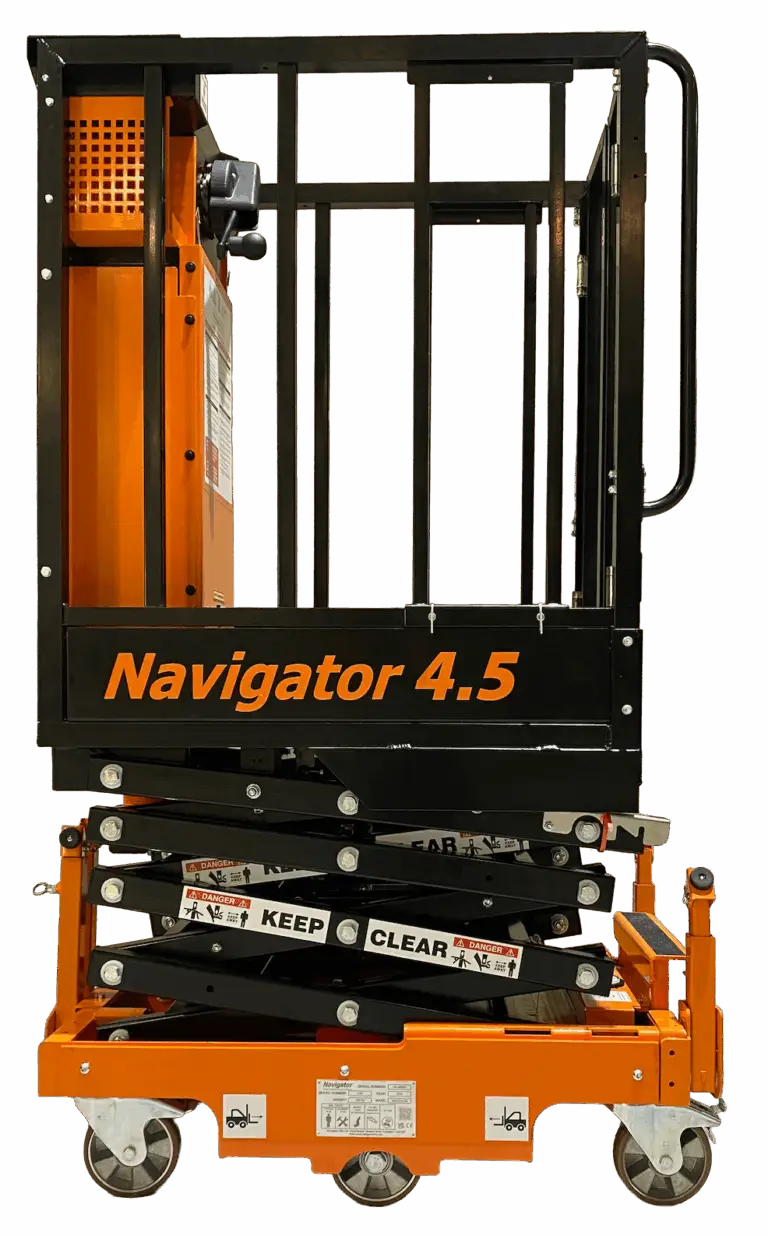
Navigator Lifts is a UK manufacturer of self-powered access platforms. Scout, Ranger, Navigator 4.5 and Navigator 6.0 cover working heights from 3.65 to 6.0 metres.
All four use manual elevation, with no batteries, charging or hydraulic lifting system. Compare the dimensions and operating limits on our Products page to decide which models merit a closer look.
Explore Navigator products ↗YOUR QUESTIONS
No. Scout, Ranger, Navigator 4.5 and Navigator 6.0 use manual elevation, with no batteries, charging or hydraulic lifting system.
Scout offers 3.65 m, Ranger 4.2 m, Navigator 4.5 offers 4.5 m and Navigator 6.0 offers 6.0 m working height. These figures are working heights, not platform heights.
Suitability varies by model and configuration. Check the specific operating manual and site conditions before selecting equipment. Ranger is described in the current range as an indoor platform. View the models and their manuals.
No. For Navigator, self-powered describes manual elevation. Do not assume powered travel or that a platform can be moved while raised; follow the model’s operating instructions.
Compare working height, overall dimensions, machine weight and permitted operating conditions. Tell us about your task and available space so we can help you assess the options. Arrange a demonstration.
LET’S TALK LOW-LEVEL ACCESS
Tell us what you need to reach, where you will work
and the space available.